jueves, 5 de noviembre de 2015

PHISICS

VECTORS.

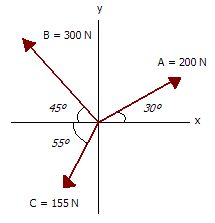
A study of motion will involve the introduction of a variety of quantities that are used to describe the physical world. Examples of such quantities include distance, displacement, speed, velocity, acceleration, force, mass, momentum, energy, work, power, etc. All these quantities can by divided into two categories -vectors and scalars. A vector quantity is a quantity that is fully described by both magnitude and direction. On the other hand, a scalar quantity is a quantity that is fully described by its magnitude. The emphasis of this unit is to understand some fundamentals about vectors and to apply the fundamentals in order to understand motion and forces that occur in two dimensions.

Examples of vector quantities that have been previously discussedinclude displacementvelocityacceleration, and force. Each of these quantities are unique in that a full description of the quantity demands that both a magnitude and a direction are listed. For example, suppose your teacher tells you "A bag of gold is located outside the classroom. To find it, displace yourself 20 meters." This statement may provide yourself enough information to pique your interest; yet, there is not enough information included in the statement to find the bag of gold. The displacement required to find the bag of gold has not been fully described. On the other hand, suppose your teacher tells you "A bag of gold is located outside the classroom. To find it, displace yourself from the center of the classroom door 20 meters in a direction 30 degrees to the west of north." This statement now provides a complete description of the displacement vector - it lists both magnitude (20 meters) and direction (30 degrees to the west of north) relative to a reference or starting position (the center of the classroom door). Vector quantities are not fully described unless both magnitude and direction are listed.Examples of vector quantities that have been previously discussedinclude displacementvelocityacceleration, and force.
Each of these quantities are unique in that a full description of the quantity demands that both a magnitude and a direction are listed. For example, suppose your teacher tells you "A bag of gold is located outside the classroom. To find it, displace yourself 20 meters." This statement may provide yourself enough information to pique your interest; yet, there is not enough information included in the statement to find the bag of gold. The displacement required to find the bag of gold has not been fully described. On the other hand, suppose your teacher tells you "A bag of gold is located outside the classroom. To find it, displace yourself from the center of the classroom door 20 meters in a direction 30 degrees to the west of north." This statement now provides a complete description of the displacement vector - it lists both magnitude (20 meters) and direction (30 degrees to the west of north) relative to a reference or starting position (the center of the classroom door). Vector quantities are not fully described unless both magnitude and direction are listed.


PHILOSOPHY

Philosophy is the study of the general and fundamental nature of reality, existence, knowledge, values, reason, mind, and language.


PLATO

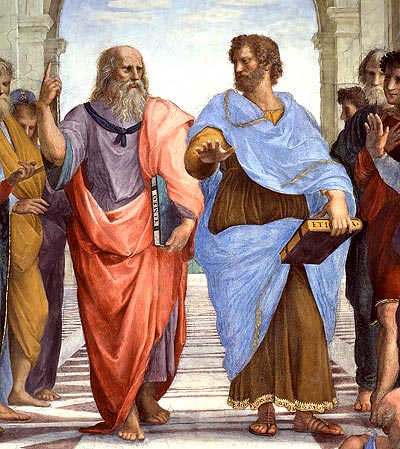
was a very important classical Greek philosopher. He lived from 427 BC to 348 BC. He was a student of Socrates and the teacher ofAristotle. Plato wrote about many ideas in philosophy that are still talked about today. In fact, one modern philosopher (Alfred North Whitehead) said that all philosophy since Plato has just been comments on his works.
Plato wrote his books in the form of dialogues—people talking about ideas, and sometimes disagreeing about them. This makes Plato's books more interesting to read.
Socrates is usually the main person in Plato's dialogues. Usually, Socrates talks with people about their ideas, and tries to see if they believe anything that is illogical. Other people in the stories often become angry with Socrates because of this. People who study Plato argue about whether Socrates really said the same things that Plato makes him say, or whether Plato just used Socrates as a character, to make the ideas he was talking about seem more important.
look at the following video...


RELIGION

religion is a set of beliefs that is held by a group of people. There are many different religions, each with a different set of beliefs. The beliefs are about the world and the people in it, about how they came into being, and what their purpose is. These beliefs are often linked to supernatural beings such as God, a number of gods or spirits. They may also be linked to an idea such as a path that the spirit of each person should take towards goodness, truth and duty. This is called spirituality. Each religion has different ideas about these things. Each religion also has a "moral code" which is a set of beliefs about how humans should act. Each religion usually has their own type of "devotions" when people worship or pray. They often have rituals (special things that are always done in the same way) for certain times of the year or certain times of a person's life.


*CATHOLIC RELIGION

Catholicism and its adjectival form Catholic are used as broad terms for describing specific traditions in the Christian churches in theology, doctrine, liturgy, ethics, and spirituality.
"Catholicism" and "Catholic" in this sense refer to the practices of several Christian churches. This sense is to be distinguished from the use of these words to refer to the Roman Catholic Church, that which is in full communion with the Holy See, as well as theOrthodox Catholic Church, which also considers it self the universal and apostolic church.

In the sense of indicating historical continuity of faith and practice from the first millennium, the term "catholic" is employed by many other historic churches which hold themselves to be "heirs of the apostolic faith". These churches consider themselves to be catholic, teaching that the term "designates the historic, orthodox mainstream of Christianity whose doctrine was defined by theecumenical councils and creeds" and as such, most Reformers "appealed to this catholic tradition and believed they were in continuity with it."

PHYSICAL EDUCATION

BASKETBALL
is a sport played by two teams of five players on a rectangular court. The objective is to shoot a ball through a hoop 18 inches (46 cm) in diameter and 10 feet (3.048 m) high mounted to a backboard at each end. Basketball is one of the world's most popular and widely viewed sports.[1] The National Basketball Association (NBA) is the most popular and widely considered to be the highest level of professional basketball in the world and NBA players are the world's best paid sportsmen, by average annual salary per player.
LOOK AT THE FOLLOWING VIDEO...

CHEMISTRY

ORGANIC CHEMISTRY

 is a chemistry subdiscipline involving the scientific study of the structure, properties, and reactions of organic compounds andorganic materials, i.e., matter in its various forms that contain carbon atoms.[1][2] Study of structure includes many physical and chemical methods to determine the chemical composition and the chemical constitution of organic compounds and materials. Study of properties includes both physical properties and chemical properties, and uses similar methods as well as methods to evaluate chemical reactivity, with the aim to understand the behavior of the organic matter in its pure form (when possible), but also in solutions, mixtures, and fabricated forms. The study of organic reactionsincludes probing their scope through use in preparation of target compounds (e.g., natural productsdrugspolymers, etc.) by chemical synthesis, as well as the focused study of the reactivities of individual organic molecules, both in the laboratory and via theoretical (in silico) study.
The range of chemicals studied in organic chemistry include hydrocarbons (compounds containing only carbon and hydrogen), as well as myriad compositions based always on carbon, but also containing other elements, especially oxygen, nitrogen, sulfur, phosphorus (these, included in many organic chemicals in biology) and the radiostable elements of the halogens.
Finally, organic compounds form the basis of all earthly life and constitute a significant part of human endeavors in chemistry. The bonding patterns open to carbon, with its valence of four—formal single, double, and triple bonds, as well as various structures with delocalized electrons—make the array of organic compounds structurally diverse, and their range of applications enormous. They either form the basis of, or are important constituents of, many commercial products including pharmaceuticalspetrochemicals and products made from them (including lubricantssolvents, etc.); plastics;fuels and explosives; etc. As indicated, the study of organic chemistry overlaps with organometallic chemistry and biochemistry, but also with medicinal chemistrypolymer chemistry, as well as many aspects of materials science.


MATH

TRIGONOMETRY


 is a branch of mathematics that studies relationships involving lengths and angles of triangles. The field emerged in the Hellenistic world during the 3rd century BC from applications of geometry to astronomical studies.
The 3rd-century astronomers first noted that the lengths of the sides of a right-angle triangle and the angles between those sides have fixed relationships: that is, if at least the length of one side and the value of one angle is known, then all other angles and lengths can be determined algorithmically. These calculations soon came to be defined as the trigonometric functions and today are pervasive in both pure and applied mathematics: fundamental methods of analysis such as the Fourier transform, for example, or the wave equation, use trigonometric functions to understandcyclical phenomena across many applications in fields as diverse as physics, mechanical and electrical engineering, music and acoustics, astronomy, ecology, and biology. Trigonometry is also the foundation of surveying.

Trigonometry is most simply associated with planar right-angle triangles (each of which is a two-dimensional triangle with one angle equal to 90 degrees). The applicability to non-right-angle triangles exists, but, since any non-right-angle triangle (on a flat plane) can be bisected to create two right-angle triangles, most problems can be reduced to calculations on right-angle triangles. Thus the majority of applications relate to right-angle triangles. One exception to this is spherical trigonometry, the study of triangles on spheres, surfaces of constant positive curvature, in elliptic geometry (a fundamental part of astronomy and navigation). Trigonometry on surfaces of negative curvature is part of hyperbolic geometry.

ENGLISH

REPORTED SPEECH


When do we use reported speech? Sometimes someone says a sentence, for example "I'm going to the cinema tonight". Later, maybe we want to tell someone else what the first person said.


Direct and indirect speech can be a source of confusion for English learners. Let's first define the terms, then look at how to talk about what someone said, and how to convert speech from direct to indirect or vice-versa.
We use a 'reporting verb' like 'say' or 'tell'.  If this verb is in the present tense, it's easy. We just put 'she says' and then the sentence:

  • Direct speech: “I like ice cream”.
  • Reported speech: She says (that) she likes ice cream.
  • We don't need to change the tense, though probably we do need to change the 'person' from 'I' to 'she', for example. We also may need to change words like 'my' and 'your'
  • (As I'm sure you know, often, we can choose if we want to use 'that' or not in English. I've put
    it in brackets () to show that it's optional. It's exactly the same if you use 'that' or if you don't use 'that'.)

    But, if the reporting verb is in the past tense, then usually we change the tenses in the reported speech:
    • Direct speech: “I like ice cream”.
    • Reported speech: She said (that) she liked ice cream.


CONDITIONALS


What are conditionals in English grammar? Sometimes we call them 'if clauses'. They describe the result of something that might happen (in the present or future) or might have happened but didn't (in the past) . They are made using different English verb tenses.
The Zero Conditional:

(if + present simple, ... present simple)
If you heat water to 100 degrees, it boils
The First Conditional:
(if + present simple, ... will + infinitive)
If it rains tomorrow, we'll go to the cinema..
The Second Conditional:
(if + past simple, ... would + infinitive)
If I had a lot of money, I would travel around the world.
The Third Conditional
(if + past perfect, ... would + have + past participle)
If I had gone to bed early, I would have caught the train
.


FALSE FRIENDS


are words in two languages (or letters in two alphabets)[1] that look or sound similar, but differ significantly in meaning. An example is the English embarrassed and the Spanish embarazada (which means pregnant), or the word sensible, which meansthoughtful in English, but sensitive in French and Spanish.